Go to the content
PROFECTRONICS
Environmental · Mobile measuring instrument

ENVIRO GO

Mobile measuring instrument for air activity. Aerosols, gaseous iodine, alpha, beta and gamma spectrometry in one housing. One person moves the measuring instrument into position.

Measuring instrument

Construction and handling

The wheel has a drive, and the brake is part of the scope of delivery. One person moves 150 kg into position, extends the mast and starts the measurement. A first indication is available after minutes, a reliable measured value in 1 hour.

  • Mass 150 to 170 kg
  • Flow rate 1 to 6 m³/h
  • Degree of protection IP54
  • Ambient −10 to 55 °C
  • Dimensions for transport 550 × 1 650 × 400 mm, mast retracted, head removed
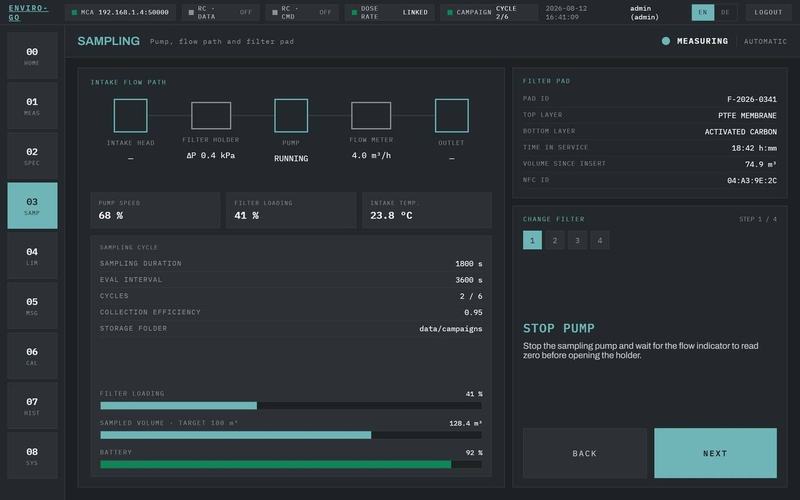
Screen · ENVIRO GO, sampling

Screenshot from the shared operating software, sampling view with flow rate, volume and time left. Operating language English, example values.

Measurement chain

Measurement chain in 6 stages

From the outside air to the result in Bq/m³, the sample goes through 6 stages.

StageAssemblyDesign
01 · IntakeIntake headTSP head with weather louvres and insect screen. Head for PM2.5 as an option.
02 · CollectionFilter padPTFE on activated charcoal, each 1 700 mm², NFC chip in the seal ring.
03 · Air flowBlowerRadial, brushless, 24 V, 250 W. The flow rate stays constant while the pad becomes clogged.
04 · CountAlpha and betaSilicon semiconductor detector, 1 700 mm², 35 %. 55 keV alpha, 30 keV beta, spectrally separated.
05 · IdentificationGamma spectrometryNaI(Tl) or HPGe in a lead chamber with 25 mm walls, with a lining of copper and tin.
06 · ReferenceVolumeReferred to 0 °C and 1 013 hPa, collection efficiency 0.95. Result in Bq/m³.

Data on the pad

The chip keeps the pad identifier, the pad type and the instrument number. It also keeps start and end in UTC, the volume, the mean flow rate, the campaign and the cycle. In addition, it keeps the 6 listed nuclides with activity and detection limit, a checksum and a link to the full report.

The chip is a copy

The full data set stays in the measuring instrument. A spectrum is too large for an NFC chip. The chip has the profile of the measurement and a link. In the default setting, the link points to the measuring instrument. The data do not have to go out of the site.
Background

Radon progeny on the filter pad

On each filter pad, the short-lived progeny of radon-222 are larger than the artificial nuclides by orders of magnitude. Without compensation, false alarms occur.

0.0 0.2 0.4 0.6 0.8 1.0 5.0 5.5 6.0 6.5 7.0 7.5 8.0 ALPHA ENERGY MEV NORMALISED COUNT RATE Am-241 5.486 MeV Po-218 6.002 MeV Po-214 7.687 MeV Artificial alpha emitter Radon progeny
Fig. 1 · Alpha spectrum at the filter, schematic. Full width at half maximum 55 keV, data from the manufacturer. The diagram shows the low-energy tail of the artificial emitter.

Alpha spectroscopy separates the radon progeny polonium-218 at 6.00 MeV and polonium-214 at 7.69 MeV from the artificial alpha emitters. An example is americium-241 at 5.49 MeV. A correction compensates for the low-energy tail.

The software adjusts the beta channel with the measured alpha-to-beta ratio of the same pad. After the compensation, the measuring instrument reports gross alpha and gross beta in Bq/m³.

Versions

Version S and version G

The 2 versions are the same, but the gamma detector is different. Intake, pad, blower, silicon detector, software and data paths are the same.

Version S · Scintillator

  • NaI(Tl) 2″ × 2″ with photomultiplier
  • Resolution approximately 7 % at 662 keV
  • No cooling, ready to measure immediately
  • Gain stabilised against temperature
  • Library with 10 to 15 nuclides
  • Power consumption up to 130 W lower than version G

Version G · High-purity germanium

  • Coaxial HPGe, 40 % relative efficiency
  • 1.90 keV at 1.33 MeV, 0.87 keV at 122 keV
  • Electric cooler, cool-down time 5 to 8 h
  • Peak-to-Compton ratio 64 : 1
  • Library with more than 50 nuclides
  • Lower detection limits with long counting times
Detection limits

Detection limits for each nuclide

In accordance with ISO 11929 at 95 %, at 4.0 m³/h and a radon level of 40 Bq/m³ in the air.

NuclideS · 1 hG · 1 hS · 24 hG · 24 h
Cs-1371.0 Bq/m³0.60 Bq/m³60 mBq/m³8.0 mBq/m³
Cs-1340.85 Bq/m³0.50 Bq/m³52 mBq/m³6.6 mBq/m³
I-1310.95 Bq/m³0.50 Bq/m³58 mBq/m³7.3 mBq/m³
Co-601.0 Bq/m³0.70 Bq/m³60 mBq/m³8.4 mBq/m³
Am-241 · alpha0.060 Bq/m³0.060 Bq/m³0.50 mBq/m³0.50 mBq/m³
Sr-90 · betanot givennot given4.5 mBq/m³4.5 mBq/m³
Gross alpha0.10 Bq/m³0.10 Bq/m³0.85 mBq/m³0.85 mBq/m³
Gross beta0.50 Bq/m³0.50 Bq/m³4.3 mBq/m³4.3 mBq/m³

Alpha and beta are the same in the 2 versions, because the 2 versions use the same silicon detector. In version S, the limit for Cs-134 increases by a factor of approximately 2 when Cs-137 is dominant. The table gives values at the level of comparable measuring instruments in the field. It does not give the values of our own calculation model. The type test sets the final values.

The Environmental Solutions overview gives the calculation of the detection limit and the radon subtraction.

Operation

Screen on the handle

Screen 1920 × 1080, control areas a minimum of 20 mm, for operation with gloves. The measuring instrument uses the same software as the stations. Operating language English.

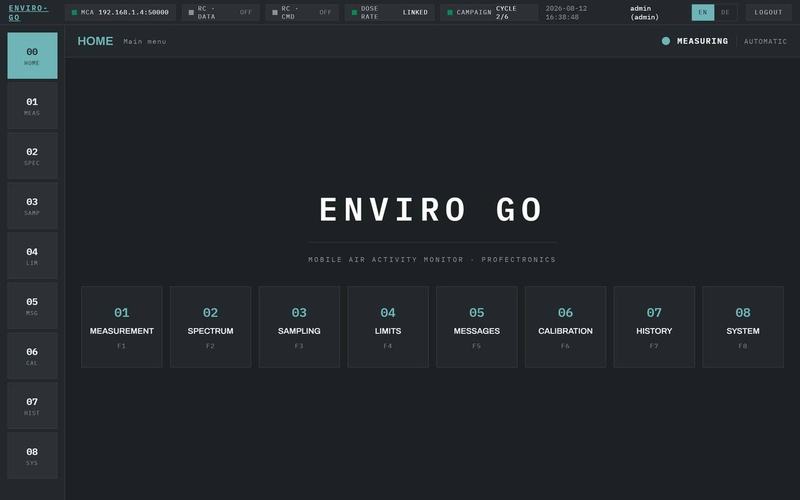
Start

One button gives access to each function.

Screen · ENVIRO GO, start screen

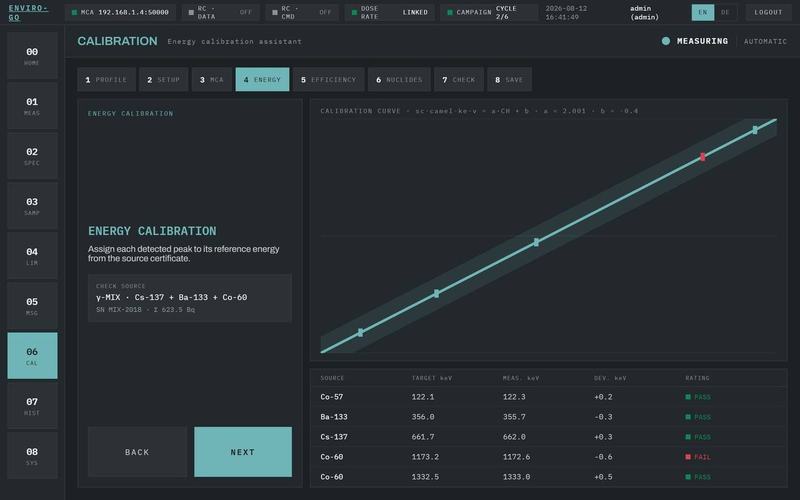
Calibration

Energy calibration curve of the gamma detector.

Screen · ENVIRO GO, energy calibration

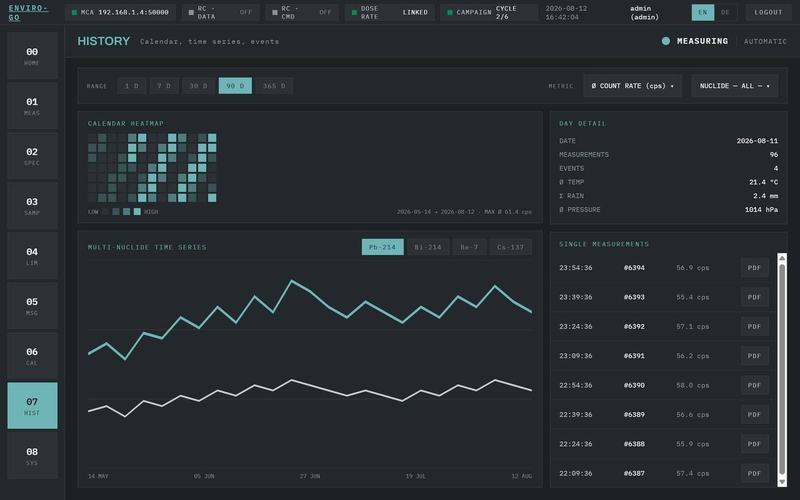
History

Calendar grid, trends and reports.

Screen · ENVIRO GO, history

Screenshots from the shared operating software. Example values, no measurements.

Programmes

Data

Report interval and interfaces

You can set the report interval from 2 minutes to several hours.

Technical data

Differences between the versions

The only differences between the versions are the gamma detector and the values that follow from the detector.

ParameterENVIRO GO SENVIRO GO G
Gamma detectorNaI(Tl) 2″ × 2″, PMTcoaxial HPGe, 40 % relative efficiency
Energy resolutionapproximately 7 % at 662 keV1.90 keV at 1.33 MeV
Coolingnoneelectric cooler
Ready to measureimmediatelyafter a cool-down time of 5 to 8 h
Nuclide library10 to 15 nuclidesmore than 50 nuclides
Peak-to-Compton rationot applicable64 : 1
Power consumptionup to 130 W lower1.2 kVA at full cooling
Mass150 kg170 kg
Technical data

Common data

These values apply to the 2 versions.

ParameterValue
Alpha and betaSilicon semiconductor detector 1 700 mm², 35 %, 55 keV alpha, 30 keV beta
Filter padPTFE on activated charcoal, each 1 700 mm², with NFC chip
Flow rate1 to 6 m³/h, nominal 4.0 m³/h, constant while the pad loads
Volumereferred to 0 °C and 1 013 hPa, collection efficiency 0.95
Shielding25 mm lead, lining of copper and tin
Power supply100 to 240 V, 50/60 Hz, mains or generator, cable 10 m
Ambient temperature−10 to 55 °C, the air conditioner keeps the inside below 40 °C
Degree of protectionIP54, outdoors below a rain hood
Dimensions for transport550 × 1 650 × 400 mm, mast retracted, head removed
Dimensions in operationapproximately 550 × 2 100 × 600 mm, turning circle approximately 1.2 m
Handlingdriven wheel, brake, support feet, one person sets up the instrument
Interfaceonly Ethernet, no radio, no mobile network modem

The detector values come from the data sheets of the component manufacturers. All other data are design values.

Scope of delivery

Scope of delivery and options

The scope of delivery includes calibration in the factory and at the installation site.

Included

  • Measuring instrument with intake head and mast
  • Air conditioner
  • Cable drum, 10 m
  • Transport beaker, without measurement geometry
  • Parking brake and support feet for the mast
  • Factory calibration certificate
  • Sphere calibration at the installation site
  • Interface description and example client

Options

  • Intake head for PM2.5
  • External uninterruptible power supply, recommended
  • External intake line
  • External ambient dose rate meter
  • Spare pads and seal rings
  • Vehicle operation through an inverter
  • Loading ramp
Validity

Development status

The measuring instrument is not built at this time. A type test on the first measuring instrument confirms or corrects the values on this page.

Each performance value on this page is a design value or a value from experience with comparable systems. The detector values come from the data sheets of the component manufacturers.

The design follows IEC 60761-1, -2 and -4, ISO 2889 and ISO 11929. We write “tested in accordance with” only after a satisfactory type test. For the CE marking in accordance with EN 61326 and EN 61010, an external test house does the tests. For the Machinery Regulation (EU) 2023/1230, Profectronics prepares a written risk assessment.

Enquiry

Enquiry and other measuring instruments

Give us the nuclide, the necessary detection limit, the measurement duration, the installation site and the date. We tell you the applicable version and the limit of the method.

Send an enquiry