Go to the content
PROFECTRONICS
Environmental Solutions

Measuring instruments for radioactivity in the environment

3 measuring instruments collect aerosols and gaseous iodine from the air and measure at the filter. ENVIRO AIR and ENVIRO NAUTA measure the gamma radiation at the location, from the air and under water.

Principles

Measurand and reference

An air activity measurement needs the sampled volume and an efficiency for the measurement geometry. Each value has an uncertainty, a decision threshold and a detection limit. The 4 principles that follow apply to the 3 measuring instruments with a filter.

Physics

Iodine-131 next to lead-214

Iodine-131 emits at 364.489 keV. The strongest line of the radon progeny lead-214 is at 351.932 keV, thus 12.56 keV from the iodine line. In the filter spectrum, it is the strongest line near the iodine line. The separation of the 2 lines in the detector sets the detection limit.

0.0 0.2 0.4 0.6 0.8 1.0 300 320 340 360 380 400 ENERGY KEV NORMALISED COUNT RATE Pb-214 · 351.932 I-131 · 364.489 NaI(Tl) · FWHM 34 keV CeBr₃ · FWHM 16 keV HPGe · FWHM 1.05 keV
Fig. 1 · 2 lines at 3 detector resolutions. Each curve has its own maximum as reference. Schematic, full widths at half maximum from manufacturer data.
DetectorFWHM at 364 keVDistance divided by FWHM
NaI(Tl), sodium iodideapproximately 34 keV0.37, one merged peak
CeBr₃, cerium bromideapproximately 16 keV0.79, stable deconvolution
HPGe, germaniumapproximately 1.05 keVapproximately 12, fully separated

FWHM: full width at half maximum. Distance between the lines 12.56 keV.

The measuring instruments subtract the radon contribution with the second line of the same nuclide. Lead-214 also emits at 295.2 keV. This line and the line at 351.9 keV have a fixed ratio of 1.933.

The ratio follows from the decay scheme. It does not drift with the weather, the radon concentration or the age of the air.

Compensation methodPrincipleRobustness
Trapezoid method2 empirical side windowsweak at the edge of the evaluation window
Reference to bismuth-214A different nuclide as referencethe equilibrium drifts
Lead-214 at 295.2 keVThe same nuclide, fixed ratio 1.933constant in time

The measuring instruments use the third method. The Station Iodine shows the subtracted contribution in the window at 364 keV next to each iodine value.

Measuring instruments

3 measuring instruments with a filter

The 3 measuring instruments collect the sample from the air on a filter. They are different in installation site, maintenance interval and measurement task.

Measuring instrumentInstallation and measurement taskCharacteristic values
ENVIRO GOMobile. One person moves the measuring instrument into position. Aerosols, gaseous iodine, alpha, beta and gamma spectrometry in one housing. For emergency operations, decommissioning and measurement campaigns.Mass 150 to 170 kg
Flow rate 1 to 6 m³/h
Cs-137 in 24 h: 8.0 to 60 mBq/m³
ENVIRO Station AerosolWalk-in measurement cabin with a magazine for 60 filters. Each day, the station puts in a new filter. The station operates for 2 months with no visit. Alpha, beta and gamma spectrometry at the filter.Service life 60 days
Flow rate 6.0 m³/h
Cs-137 in 24 h: 5.0 to 25 mBq/m³
ENVIRO Station IodineMeasurement cabin. Measures iodine-131 in the air. Prefilter and TEDA cartridge in the changer, counted separately. Cerium bromide detector. One visit each year.Cartridge 2 months
Detector CeBr₃ 2″ × 2″
I-131 in 24 h: 40 mBq/m³

Detection limits in accordance with ISO 11929 at 95 % and a radon level of 40 Bq/m³ in the air. For the ENVIRO GO and the Station Aerosol, the range gives the scintillator version and the germanium version. For the source of the values, refer to the section “Development status”.

Applications

Fields of application

The measuring instruments are applicable to fixed measurement points, plant surroundings, mobile operations and remote sites.

Common basis

Evaluation, calibration and data paths

The measuring instruments use the same evaluation, the same operating software and the same data paths. The calculation is the same for all results.

Detection limit with simultaneous sampling and counting

c(DL) = 2 · ( 2.71 + 4.65 · √B ) / ( ε · p · η · V · t )

The factor 2 compensates for simultaneous sampling and counting. The filter loads only during the measurement. At a constant concentration, the mean activity on the filter is half of the final value. Without the factor 2, the calculation gives a detection limit that is not possible in the field.

In an iodine measurement, B is the remainder after the radon subtraction, not the counting statistics of an empty detector. Thus the radon subtraction sets the detection limit for iodine-131.

Relation to the measurement time

The volume increases with the collection time: V = Q · t at a constant flow rate Q. Thus the time t is 2 times in the denominator. If the background is low, the detection limit decreases with 1/t².

If the background is dominant, B increases proportionally to t. In this case, the detection limit decreases with 1/t1.5. The 2 cases apply to a long-lived nuclide at a constant concentration. For iodine-131, the decay with a half-life of 8.02 days limits the gain from long measurement times.

The relation with 1/t² and 1/t1.5 applies when the collection time is equal to the counting time. The cycle ranges in the tables of the stations are an approximation for the counting window with a fully loaded filter. There, the volume does not increase with the counting time. Thus the ranges follow from 1/t and 1/√t.

Background from a prediction model

A compact model with 2 hidden layers (64 and 32 neurons) links 4 principal components of the spectrum with pressure, humidity, temperature and a radon proxy. Compared to a fixed baseline, the mean squared error of the background estimate decreases by 35 to 50 %. The software calculates the reported values in accordance with ISO 11929 with the classical method.

5 checks before the software uses the model

Completeness of the input quantities, distribution drift with a Kolmogorov-Smirnov test, spread over 50 runs, physical limits and confirmation by the supervisor. Each stage has a defined fallback to the classical evaluation. The audit log records each decision.

One user interface for all measuring instruments

Screen 1920 × 1080, control areas a minimum of 20 mm, for operation with gloves. 3 roles and 11 rights that you can give separately. The audit log records each action that has an effect on a result. The assessment body has read access.

Data storage in the measuring instrument

Raw data at an interval of 2 minutes, a report each 10 minutes, you can adjust the 2 values. The stations also have a ring buffer for a minimum of 3 years. If the connection stops, no data are lost. The measuring instrument sends the data when the connection is available again. The encrypted USB stick is a handover copy, never the original.
Other measuring instruments

Gamma spectrometry without a filter

ENVIRO AIR and ENVIRO NAUTA measure the gamma radiation at the location. They do not pull air through a filter. ENVIRO AIR measures from the air, ENVIRO NAUTA under water.

Measuring instrumentApplicationFeatures
ENVIRO AIRAir and vehicle. Gamma spectrometry as a drone payload, in a vehicle or at a fixed point. For an overview and for mapping over an area.Mapping with position data
Detector of your choice, multichannel analyser on board
No sampling, no result in Bq/m³
ENVIRO NAUTAUnder water. In-situ gamma spectrometry in fresh water and sea water, with no sampling on land.Operating depth up to 100 m
Data storage on board up to 5 years
Power consumption less than 2 W
Detector of your choice, multichannel analyser on board

There is no data sheet for ENVIRO AIR and ENVIRO NAUTA. No measurement and no data sheet confirms the data for these 2 measuring instruments. Thus the pages give no detection limits.

Validity

Development status

The measurement chains have no type test at this time.

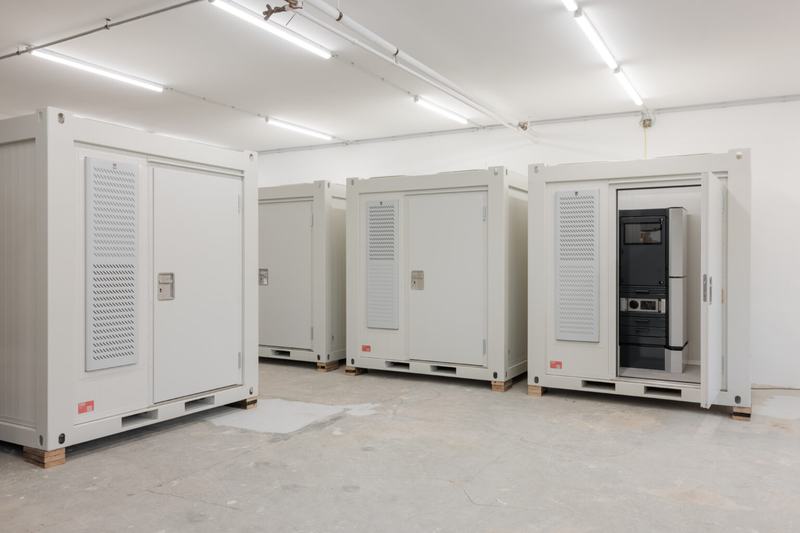
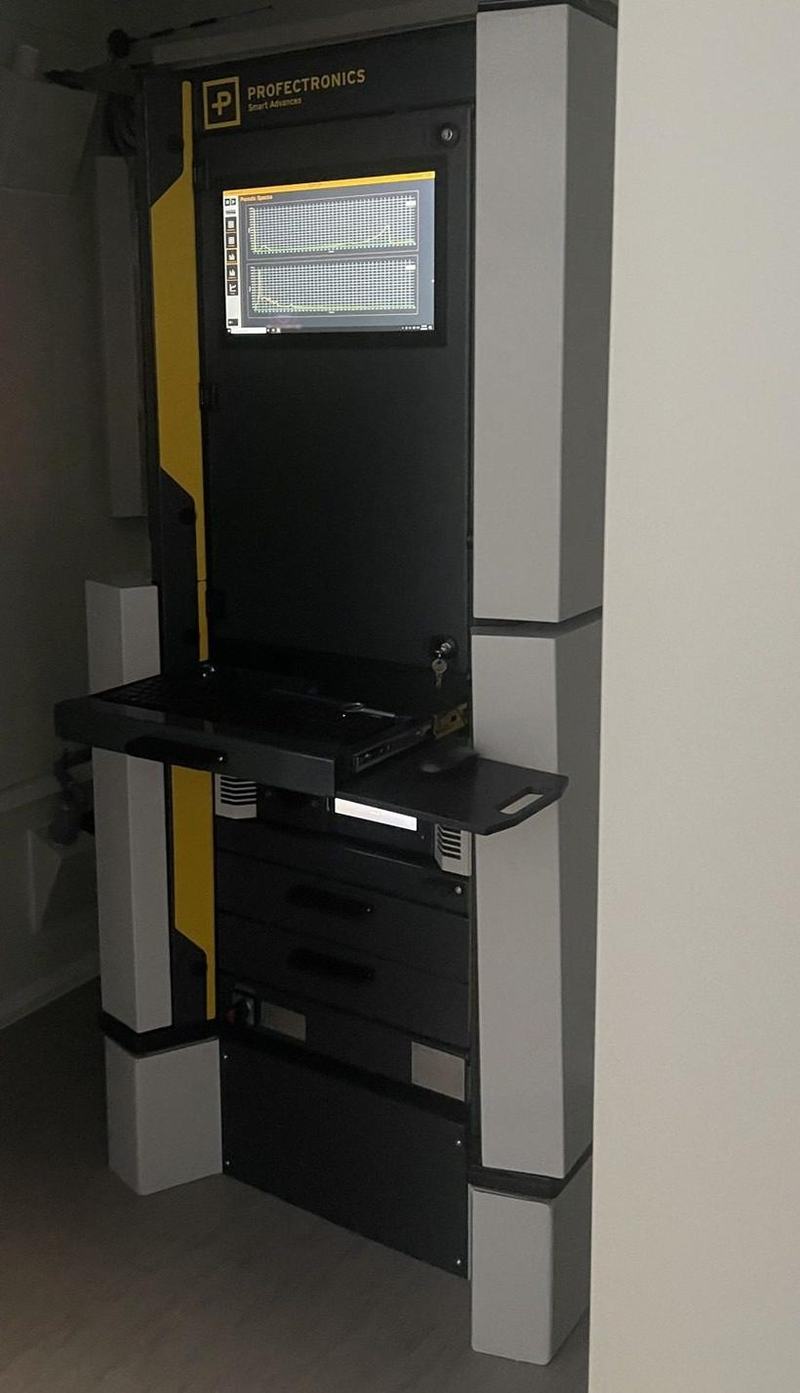
The ENVIRO GO is not built at this time. Measurement cabins of the 2 stations are built in this design. The photographs on this page show them.

Each performance value for the ENVIRO GO and the 2 stations is a design value or a value from experience with comparable systems. The detector values come from the data sheets of the component manufacturers. The data for ENVIRO AIR and ENVIRO NAUTA are not confirmed.

The design follows IEC 60761-1, -2 and -4, IEC 61171, ISO 2889, ISO 18417 and ISO 11929. We write “tested in accordance with” only after a satisfactory type test. Profectronics states conformity only with proof. For the CE marking in accordance with EN 61326 and EN 61010, an external test house does the tests.

Photo · Measurement cabins in the hall
Photo · Measurement cabinet in the measurement cabin
Enquiry

Data for an enquiry about measuring instruments

An enquiry about measuring instruments needs only 5 items of data. A customer specification helps, but it is not a condition.

Send an enquiry